Showing posts with label think differently. Show all posts

Wednesday, November 16, 2011

Communication Trends—How Google and Facebook Are Shaping Your View of Reality


In this TED Talk, Eli Pariser pulls back the curtain on the filtering techniques of Google and Facebook, reminding us that your news and information is now being filtered by someone else. Searches now bring up information tailored to you—so two people sitting next to each other and searching for the same thing will get entirely different results.

Pariser says the torch is being passed from human gatekeepers to algorithmic gatekeepers, which don’t have imbedded the ethics that humans are capable of. Right now these algorithms decide what we get to see—and what we don’t get to see—based on relevance to us. What they don’t show us are differing points of view, information that is important, uncomfortable and perhaps even challenging—creating a reality with us as the center.

Pariser suggests that these algorithms must be coded in a way that supports a sense of public life, a sense of civic responsibility—and that they are transparent enough so that we can both understand and have some control over the kinds of information we access.

This 8-minute video is a must-see.

Monday, October 3, 2011

Holiday E-Cards Are Environmentally Friendly

Now’s the time to think about your holiday message to your clients. Instead of the traditional, ho-hum preprinted holiday card, do something original, high impact and environmentally friendly—an e-card.

Here are a few examples of work we’ve done in the past:
The holidays are a time to create a breathe in the working world—introducing ideas that speak to deeper issues in the human heart. Use your card to acknowledge your gratitude for your clients’ patronage, convey a mutually held value, or introduce an artful and inspiring message that provides a momentary oasis for the recipient. We promise you, it will be far more impactful and welcome than an impersonal, imprinted card.

Wednesday, September 21, 2011

What's the Deal with Google+ ?

You've probably been hearing about the new Google+, so for those of you still scratching your heads, this video provides a quick summary of what Google+ is about. 


Tuesday, August 30, 2011

Selling or Telling: Make Your Company an Information Destination


We’re not ready to suggest that selling isn’t still an important part of any business’s marketing efforts, but we also recognize that in the age of information, there’s untapped power in becoming a destination for trusted information.

Consumers are hungry for good information, and have the means to find it. Although we want coupons for free coffee and discounts from our favorite retailer—we are equally or more hungry for the most definitive, recent information on our topic of choice.

If you’re seeing social media as a way to “talk at” your consumers, you won’t likely build a robust following. But if you consistently deliver the trustworthy information they’re hungry for, they’ll be back for more. If they come to see you as a trusted source of information, this will develop a stronger bond than a sales message can.

According to a Constant Contact blog, roughly 78% of consumers prefer to get company information from helpful articles instead of an ad, and 61% of those are more likely to buy as a result of receiving this content.

Making content that benefits the consumer instead of selling yourself is a winning strategy. But don’t be discouraged by this. Take small steps towards this goal, and remember it takes time to move into an entirely new paradigm.

What are your most trusted sources for information?

Thursday, June 9, 2011

Good Photos Are a Marketer's Secret Weapon

Photos say things words cannot.

In the examples here, the photos say professional or unprofessional, friendly or distant, engaged or posed. We see far too many bad pictures in general—photos that actually detract from the kind of message the organization is trying to convey.

Why is this? Well, often it's a matter of vision. Marketers who understand the power of a good photo budget for a professionally-taken collection with which to work. In the same way that hiring the right architect can make all the difference in a first impression for your building, hiring the right photographer can make all the difference in a first impression for your company.

Anyone can take a photo, but it takes a skilled professional to make a photo tell a compelling story—and do it in a way that reflects handsomely on your organization. The black and white photos below were taken for our client St. Anthony North Hospital by one of our partner photographers (we have a small group of hand-picked, top-drawer photographers in the markets where we regularly do work).

Some believe that professional photography is too expensive, but we say that amateur photography actually costs the organization too much in terms of image.

There are ways to get the most from your photography budget, and we'll talk more about that in a future post. But professional photography is an absolute necessity for any organization attentive to their public image.

So now let's hear from you. Based on the pictures below, what kind of impressions do have about the organizations represented?


Thursday, May 12, 2011

Twitter Proves Ideal for Crises Communication

Twitter is proving itself more useful than founder Jack Dorsey ever could have anticipated.

After the earthquake in Japan, when local phone networks became overloaded, people turned to Twitter—and other social media sites—for their communication.


Twitter Japan used their page to send out helpful information to their followers in both English and Japanese, including several general hashtags for people to use (for those that are new to Twitter, hashtags allow people to easily search tweets for keywords that are proceeded by the # symbol). These tags for the Japanese earthquake included:
•   #Jishin—general earthquake information
•   #J_j_helpme—requests for rescue or other aid
•   #Hinan—evacuation information

On March 12, the most common hashtag—general earthquake information—was mentioned almost 400,000 times in tweets.

In the revolution in Tunisia, Twitter was also responsible for sending out warnings to people, for organizing protests and for making calls for help. Below are some of the tweets sent out during the revolution.

Then there is also the original Twitter story of James Karl Buck, a graduate student who was covering the protests in Egypt and was arrested. His one-word tweet "arrested" was sent to his Twitter followers and within moments they were working on getting him out of jail.

These stories hint at the power social media sites like Twitter and Facebook have—in the right application.

Thursday, April 14, 2011

Client Showcase—Animation Can Fuel Web Traffic

We developed a promotional campaign for Dimensions Pain Management, a medical clinic in Colorado, and recommended the addition of kinetic typography to use in social media applications. We've not only found that the presence of an animation increases traffic on our own site, but in industries like health care and law, it's still fairly young and so is a way to get your message noticed. It provides a fresh way of conveying your message in a media that is versatile and can be used in many ways—from posting on one's site, YouTube and Facebook page to sending links via email.

The addition of motion and sound amps up a message and delivers it in a way that keeps the viewer's interest. Kinetic typography and other animations can be simple, like this one, or far more complex. They can be used for anything from a new service launch to infusing your Web page with new life. We've also applied them to seasonal e-cards like these: CMBell Company Holiday Animation, Gresham Savage 100 Year E-Card, Gresham Savage Holiday E-Card

We love working in this medium and think it holds a lot of promise for business—given the apparent appetite consumers have for productions like these.

Thursday, April 7, 2011

Are customer service programs for you?


Over the years we've studied with interest what makes great customer service. Some companies, like Disney, have an extensive training program for employees that teach specific actions and attitudes required to deliver an exceptional customer experience. 

Others have attempted to imitate this, but have missed the mark by focusing on scripts instead of a mindset of service.

I recently experienced this at a national retailer. Having scoured the floor for someone to help, I finally found someone to let me into the dressing room. While the clerk had paid no attention to me whatsoever (though there were hardly any other clients to tend to), when I finally made my purchase, she was quick to recite the required script inviting me to go online and rate her service as excellent. I found it even more ridiculous to hear her answer the phone using the requisite (but unconvincing) script about the excellent service one could expect when shopping at this store.

Creating an exceptional customer experience requires considering every touchpoint a client has with a brand. Organizations that focus on syrupy scripts but who fail to train their workers on their products and on their service standards come across as shallow and disingenuous.

The more I study this topic, the more I'm convinced that while customer service training can have its place, the most important thing a business can do is to hire people who instinctively understand what service is aboutand who care about their work. Like common sense, people seem to either have this ability—or not.

Tuesday, March 8, 2011

Need inspiration? Step into your right brain

Jill Bolte Taylor, a brain scientist, suffered a stroke in the left side of her brain and learned what it really means to be a right-brained thinker. She's spent the last eight years recovering her ability to think, walk and talk, and has now become a major advocate for stroke recovery.

From her experiences she hopes she can inspire others to think differently about thinking. "Right here, right now, I can step into the consciousness of my right hemisphere... [where] I am the the life-force power of the 50 trillion beautiful molecular geniuses that make up my form, at one with all that is. Or, I can choose to step into the consciousness of my left hemisphere where I become a single individual, a solid. Separate from the flow, separate from you."


Innovation comes from right-brain thinking. So when lacking inspiration, try stepping out of the structured left-hemisphere of your brain and into the creativity of the right. Selfgrowth.com lists several ways you can tap into the power of right-brain thinking:
  • Use your non-dominant hand.  If you are right-handed, trying using your left hand for common activities such as brushing your teeth or combing your hair. 
  • Try some brain boosting body moves. Certain body moves are known to balance the brain, such as juggling, walking while swinging opposite arms and legs, and marching on the spot all help to get the left and right side of the brain working together.
  • Do some creative planning.  Doodle rather than writing word lists or linear notes. You can daydream, scribble and sketch your way through a problem-solving session and find yourself stress-free and resourceful when you emerge from the other side.
Regardless of what your natural brain lead is, you can develop both sides.


Monday, February 21, 2011

Reputation or character?


Legendary UCLA Coach Wooden understood how to inspire success in others. His focus on character was foundational to his leadership. As he put it, character is what you are, and reputation is what you are perceived to be. This is true not only of people, but of companies. Although our work as communicators is about building reputation, it is always in adjunct to the organization’s work to be a company of character.

Wooden also believed that how we make the journey is more important than our final destination, and redefines winning by how we conduct ourselves along the way. “You can outscore another team and lose, and you can be outscored by another team and win,” he says in this inspirational interview.

Thursday, November 18, 2010

You Can Be Indispensible


Ever notice how easy it is for all of us to see all that is wrong with the world? Anyone can point out problems, but it's the one who brings solutions to their organizations that stands out.

You will be surprised how quickly you can distinguish yourself by observing this one simple rule. By seeing and addressing the strategic issues that impact the success and future of the organization, you can establish yourself as a visionary, a leader and a valuable member of the team.

More often than not this requires more persistence and positive attitude than it does brilliance. As Albert Einstein once said, "It's not that I'm so smart, it's just that I stay with problems longer."

Thursday, November 4, 2010

Reaching the 18- to 29-Year-Old


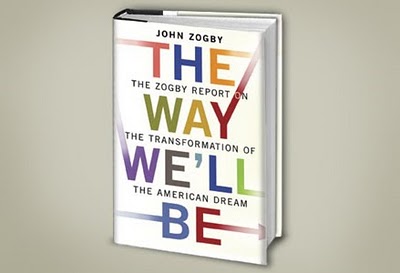
In John Zogby's fascinating book, The Way We'll Be, he offers insights into how 18- to 29-year-olds think:
  • They care about more than just themselves—contrary to how they've been depicted
  • They celebrate diversity—and expect marketers to realize that
  • They think and buy globally, and travel extensively
  • Just about everything in their lives is public, and they're far more comfortable with this lack of privacy than their parents
  • Their space is the Internet—and they're easily accessible through social media
Whatever your business, you'll likely need to be talking with (not to) this demographic. Zogby helps start the interesting and relevant conversation about how best to engage them.

Source: The Way We'll Be, John Zogby. Buy it here.

Monday, April 26, 2010

What business are you really in?

The railroads thought they were in the business of running railroads, which kept them from seeing bigger threats and opportunities. In reality, they were in the business of transportation, and it was air travel that posed the biggest threat—not faster or better railroads.

This misguided view of one's true competition is still prevalent today. For example, healthcare at times suffers from a similar myopic viewpoint. Healthcare professionals see themselves as being in the business of saving lives and promoting health. But in fact, at times they are unable to fully promise either. Perhaps it is closer to the truth to say that they are in the business of restoring dignity and instilling hope—as well as offering medical interventions. Imagine how this idea might transform how hospitals deliver care.

Whatever your industry, think hard about what you are really selling. It may lead you to the next big idea—while failing to do so may prevent you from seeing your true competitive threats.

Monday, March 29, 2010

Are you the company theater director?

A wise and wonderful client who spearheads a successful healthcare philanthropy program described her role as theater director—the person who stages experiences between donors and her facility. I love this description and think it describes what good marketers do, too.

"I don't ask for money," she says, describing her refreshing way of viewing of fund raising. Instead, she tells the story and lets it do its work. "I know it's unconventional, yet we don't have enough staff to process all the donations people want to make to our facility."

What experiences are you creating for your customers?

Friday, March 19, 2010

The American Dream in Transition: What Americans Really Think

In his insightful book, The Way We'll Be, veteran pollster John Zogsby draws on thousands of surveys to reveal four megatrends that are shaping how Americans view the world:
  • Living with limits as consumers and citizens
  • Embracing diversity of views and ways of life
  • Looking inward to find spiritual comfort
  • Demanding authenticity from the media, our leaders and institutions

Led by today's 18-29-year-olds, America's first "global" generation, Americans are becoming more internationalist, consensus-oriented and environmentally conscious—and less willing to identify themselves by what they do or how they spend their money.

Leaders and marketers who want to better understand how Americans think and what they believe will find this a valuable read.

Monday, March 1, 2010

Fingers in the Sand: The Power of Images


In this moving and remarkable artistic interpretation of how ordinary people were affected by World War II, 24-year-old Kseniya Simonova uses her fingers to draw a series of images on an illuminated sand table. She won the top prize on Ukraine’s Got Talent with her artistic presentation.

The scene morphs from a happy couple holding hands to warplanes appearing, then to a tearful face of a woman whose smile returns with the arrival of a baby. We next see a woman’s wrinkled, sad face turn into a monument to a soldier, and in the final scene, mother and child bid farewell to a man outside.

In Ukraine, the war resulted in one of every four of their citizens being killed—11 million deaths. Simonova’s unusual style show us once again the power of images to move something deep inside of us—to say things that words cannot.

Friday, December 11, 2009

What Conducting an Orchestra Tells Us About Leadership


Ben Zander, the flamboyant conductor of the Boston Philharmonic Orchestra and the Youth Philharmonic, says he remembers the day it dawned on him that the conductor doesn't make a sound on his own. He simply uses his power to awaken possibilities in other people.

You can tell what is happening with a player by his shining eyes, explains Zander. As a leader, the question is this: Who am I being that results in my players' eyes not shining?

Zander's passion inspires us to lead in our organizations by the words we use and the fire in our heart. This lively talk will make you laugh, energize you and help you see new possibilities in yourself and others.


Monday, November 16, 2009

The Brain That Changes Itself

For 400 years, mainstream medicine and science believed that brain anatomy was fixed. The common wisdom was that after childhood the brain changed only when it began the long process of decline; that when brain cells failed to develop properly, or were injured, or died, they could not be replaced. Nor could the brain ever alter its structure and find a new way to function if part of it was damaged... [This] theory decreed that people who were born with brain or mental limitations, or who sustained brain damage, would be limited...for life.

We now know that the brain changes its structure with each different activity it performs, and that if certain parts fail, other parts sometimes take over. This process, called neuroplasticity, has been the most significant learning about the brain since its basic anatomy was first mapped.

The Brain That Changes Itself is a fascinating must-read that chronicles stories of how this theory is impacting people once labeled retarded, those with learning disabilities, stroke victims, those with OCD, and others whose brains have failed them in traditional ways.

Order this book by Norman Doidge, MD here.

Source: Paraphrased and quoted from the book's preface.

Copyright © 2009 CMBell Company, Inc.

Unless otherwise credited, all content copyrighted by CMBell Company.