
Showing posts with label writing. Show all posts

Wednesday, October 19, 2011

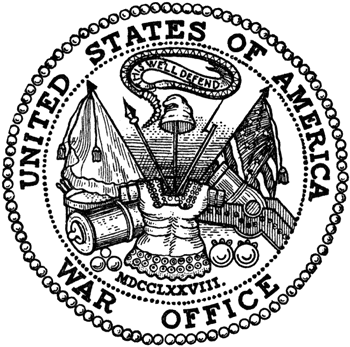
Department of War or Defense: Words Matter


From 1789 until 1947 the department responsible for the operation of the United States Army was called the War Department. In 1947, it was renamed the Department of Defense.

Play along with us on this little turn of words, if you will, and ask yourself which you’d rather support with your tax dollars: a war department? Or a department of defense?

See the different feelings these two names for the same thing evoke? It’s much easier to rally support for defense then war. And so we see yet another example of how much a word matters in evoking a desired response.

What words in your business might need rethinking?

Thursday, May 26, 2011

On Writing Well—Don't Make 'em Work For It


Readers are impatient, and don’t want to invest their precious time in a message that doesn’t concern them. Good writers know they’ll have one shot to get the reader’s attention, so copy should pass the “drive-by” test. If, in the space of a three-second glance, one cannot tell what your offer is, don’t expect your reader to stay longer to figure it out.

The challenge, of course, is that you can’t say everything in the headline, or even the first sentence. And it’s easy to assume too much about the reader. When in doubt, ask someone unfamiliar with your topic to read the copy and stop when they’ve decided they’re no long interested. Or ask them to read only the headline and tell them what they think the ad will be about.

You might be surprised at what you learn.

Thursday, May 5, 2011

Hospital Anniversary Campaign—Outdoor Advertising


This week we're following the launch of a hospital anniversary campaign for our client, St. Anthony North Hospital in North Metro Denver. Today we're featuring their outdoor elements. Outdoor advertising is a good supporting media, and although it can't tell the full story, it can reinforce the key messages. Creatively speaking, it is the hardest to develop because the message must be so short in order to be read quickly.

See how the transit and outdoor ads above support the hospital's broader messages for their 40-year anniversary campaign.

Check back tomorrow to view the entertaining employee video for this campaign, and see how to engage your own workforce in your organization's strategic messages.

Tuesday, April 26, 2011

Use a Word Only When a Picture Won’t Do

Always reduce your message to its most simple and compelling form. We like to start a campaign by developing the creative concept for outdoor advertising, which is the most difficult because it’s read so quickly. In a matter of seconds, the ad must convey:
·   A message that gets the reader’s attention
·   A promise that’s relevant to the reader
·   What is being “sold”
·   Who is doing the selling
·   How the reader can “buy”


See if you can supplement words with images that help telegraph the message more quickly. For example, on the outdoor board shown here, we rely on the blue man image to make it clear that the headline is referring to back pain. We rely on the logo to identify the service as a hospital—and not a fitness center. This means we can use those last remaining delicious words to get the reader’s attention and make a promise.

When you’re writing, ask yourself whether a picture or a word is the most efficient way to convey an idea. Think visually while you write. You’ll find that by introducing an image, you can trim out excess words and make it easier for your reader to decide if this is a message he or she cares about.

Monday, March 28, 2011

Make Your Ad More Readable

We writers love words. But oh, how hard it is to sometimes pare them down.

There is, after all, often much to say about a good product or service. But to make your ad readable:

1. Limit your message to one or two strong points.
 2. Be  accurate and truthful. Readers will disdain your company if they discover you've misled them.
 3. Make the headline do the heavy lifting. Only about five percent of viewers will read your copy—but 30% will read your headline. You can even try grouping the two together.
 4. Make your typeface readable.  Use serif typefaces and avoid reversed type that can be hard to read.

In the ad below, the body copy is too long and too hard to read. Not only is the small copy hard to read in sans serif, but the contrast between the background and text is too low.


Conversely, this ad by Wieden+Kennedy Amsterdam uses readable body copy. The serif copy is black on a cream background for optimum contrast—and the pairing of the graphic image with the typeface strengthens the message.

Thursday, March 17, 2011

Wait! Don’t Use That Typeface!

We love typography. A beautifully shaped letter infuses style and emotion into a simple word in the same way that a beautiful fabric brings life to a garment. It serves as both art and utility.

When a spoken word floats into the air it enters the world bare, without the dress of a correlating visual font. The type selected conveys a mood—anything from dignity or silliness to boldness, strength or power. 

We often know the effects of well-chosen type but can’t explain its power over us to make us feel a certain way.  For example, what kind of connotations do the following fonts have for you?


The selection of typography is no less important than how you dress for an important meeting or presentation. It can make the difference between being perceived as savvy and professional—or as amateur and lacking in credibility. So next time you’re tempted to dash out a memo in Comic Sans, think again. Maybe it’s time to call in an expert who can help you be sure that your font is saying exactly what you want it to say about you.

Thursday, January 27, 2011

Advertising Savvy—Craft Catchy Headlines

For headlines to be effective, they must be engaging and connect with the reader. The best headlines resonate emotionally with viewers, either amusing them, unsettling them, or making them curious or thoughtful.

Compare the headline in this first ad with that in the second. 

The second ad, by STIR, features a short but arresting headline. Only four words long, it speaks to a legitimate fear, luring the reader into the copy in search of the promise.


Which one most compelled you to read on?

Wednesday, January 12, 2011

What Every Headline Knows

Words all have their jobs. The headline’s job is to get you to read the subhead, and the subhead’s job is to get you to read the copy. Sometimes a caption or bullet list stand in for these.

These are the gatekeepers to the message—so pick them with care, test them on innocent bystanders, and then rewrite them until you’re sure they work. Here's how it works.

Start with a killer headline.

{Like that. See, you want more.}

Make them a promise they can’t refuse.

{Want more?}

OK, I’m going to stop there—I don’t want to spoil the fun by writing the whole story, but I think you get the point. Make those headlines do their job, or send them to headline heaven and spare the reader the yawn—and your client a wasted encounter.

Thursday, December 30, 2010

There's No Such Thing as Good Writing

Only good rewriting.

One of my college writing professors drilled this into our heads, and I confess it’s one of the few lines I remember from that class. But it has served me well in times of writing—especially when writing ad copy, where the allocated space is so spare. Every word simply must do its job. Every nuance has to be considered. We often have full-on discussions about a single word or phrase.

Did they clamor or bellow? Was it disturbing or agitating? Did he flinch or recoil?  See how each word has a slightly different meaning?

Writing isn’t unlike gardening, for those of you warm to that metaphor. It takes patience, tending, and lots of weeding (sometimes even replanting). It’s also like cooking. It often has to marinate to get the full flavor.

So don’t be discouraged if the first words out aren’t show-stoppers. They rarely are. But they often give birth to the perfect word, given time and effort. And that’s the difference between ordinary writing and great writing.

Monday, October 4, 2010

Test Your Tagline

Is your tagline a winner?

Maybe. Is it simple? Succinct? Believable? Clear? Original?

The Tagline Guru offers 20 attributes on which you can rate your tagline. To find out if your tagline is genius, or a snoozer, take this quick test.

http://www.taglineguru.com/tagline_iq.html

Thursday, September 16, 2010

The Word Doctor—Use Short, Fresh Words

As Theodore Rees Cheney says in Getting the Words Right, "a writer in our business needs a store of expressive words"—not a storehouse of long, complex Latin-derived words.

The right words breathe life into your message and help the reader envision more vivid visual images. As Cheney says, consider words like break, scatter or glimmer. These short words "are concrete and create immediate sense impressions." Here's an example:

Before: If I take the time to look outside of my window during the day, I can see a street covered with snow and ice. People are carrying their briefcases, packages and handbags and trying to balance themselves with care so as not to slip on the ice and fall.

After: The streets outside my window are covered with snow. Fearful people, clinging to their wares, shuffle cautiously to avoid a fall.

(Cheney, p. 157-158)

Monday, September 6, 2010

Six Tagline Mistakes to Avoid

A tagline works because of how it sounds, how it looks, how memorable it is and how easily it conveys a brand promise. Creating taglines is some of the most difficult writing, because so much is demanded from so few words.
We can all name taglines that worked, like:
  • Just do it (Nike)
  • Got milk? (California Milk Processor Board)
  • Where's the beef? (Wendy's)
  • Think different. (Apple Computer)
  • Melts in your mouth, not in your hands. (M&Ms)
  • It takes a licking and keeps on ticking. (Timex)
But here are some that we're not so sure of:
  • We're Exxon. (Exxon)
  • We're chicken. (Tyson)
  • Is that Playtex under there? (Platex)
Here are pitfalls a good tagline should avoid--from the Tagline Guru (a site worth visiting, by the way):
  1. Being cliche.
  2. Being bland or boring.
  3. Attempting to imitate another good tagline.
  4. Not being true to your brand.
  5. Being self-serving.
  6. Using complex, long words.

Read more about these tagline mistakes at taglineguru.com


Monday, August 9, 2010

The Word Doctor: Use Punchy Verbs

A simple verb does its job—but not necessarily enthusiastically.

“The can ran across the floor and ran into the pillow.”

Sometimes writers, in search of excitement, will spread modifiers throughout their sentence, like this:

“The can ran swiftly across the wood floor and ran head-first into the pillow.”

Snooze worthy. But punchier verbs work even better.

“The cat sprinted across the floor and collided with the pillow.”

See the difference? A strong verb has a way of including modifier-like qualities without adding more words.

Tuesday, July 20, 2010

The Word Doctor: Be Active

Compare these sentences:

“The bottle was opened by Spencer. “

It sounds awkward because it is. People don’t speak in passive voice, which is why writing in passive voice doesn’t resonate with readers. Active voice orders sentences more naturally:

“Spencer opened the bottle.”

Notice how “James saw the bird fly over the man and ruin his day” sounds much better than, “The bird that flew over the man and ruined his day was seen by James.”

Avoid passive verbs and you’ll avoid passive voice. There’s no need to be passive about being active.

Monday, June 21, 2010

The Word Doctor—Excise Idle Words

Some words are known for contributing little to a sentence. A good example is "there is." See how excising this improves these sentences:

Before: There is something terrible happening here today!
After: Something terrible is happening!

Losing the dead wood in your writing will make your copy easier to read and punchier.

Thursday, March 4, 2010

The Word Doctor—Use Shorter Words

Why use a long word when a short one will do?

For example:
Exacerbate = inflame
Fortuitous = lucky
Arrogant = aloof
Imperative = crucial
Administer = give

Too much writing is still plagued with long words that make reading tedious. While it's tempting to think one sounds sophisticated, great writers know that it is the size of the idea—not the words—that impresses.

Friday, January 15, 2010

What a Pollster Can Tell You About Reaching Consumers

Are you reaching America's consumers with messages they care about? Consider these four emerging consumer perspectives as you craft your firm's messaging:

1. Individualistic
America has always had a distinctly individualistic view of life, but this characteristic is becoming even more pronounced as consumers find their hopes in institutions dashed. Choice, independence, and personalized service are messages they warm to.

2. Yet global
Even as their trust in institutions declines, they are not just focused on their own corner of the planet. Their interests are global, not just local, and they connect with organizations with similar interests.

3. Interested in sustainability
Consumers, especially the younger ones, want sustainability, and want to do business with companies that share those values. Demonstrating your company's focus on global sustainability—not just national—will resonate with them.

4. Not just young
Retirees are living longer and hold vast resources of discretionary income. But they're looking for more than just relaxation. Talk to them about matters they care about and that contribute meaning to their lives—and tap into their life experiences within your own organization.

Source: The Way We'll Be, John Zogsby, Chapter 3. Buy it here.

Friday, November 6, 2009

The Word Doctor—Be Concise

As my college professor ingrained in me, there is no such thing as good writing—only good re-writing. Almost always, a sentence can be improved by shortening it in the editing process. For example:

Before: It is always the case that by the end of the day we aren't finished with the projects that were assigned to us.
After: We're never done by the end of the day.

It takes more time to write concisely, so it can easily be mistaken as an effortless task. But don't let brevity fool you. To paraphrase Mark Twain, If I had more time, I would have made it shorter.

Copyright © 2009 CMBell Company, Inc.

Unless otherwise credited, all content copyrighted by CMBell Company.